
How to Answer Multiple-Choice Questions When You Aren't Sure of the Answer
Learn practical strategies and reasoning techniques to make smart, educated guesses on multiple-choice questions even when you're uncertain of the correct answer.
Materials
- The test or practice exam
- Pencil or pen (for paper-based tests)
- Scratch paper (if permitted)
Before you start
- Basic reading comprehension
- Familiarity with the general subject of the test
Step 1 of 6

Read the Question Carefully Before Looking at the Options
Before glancing at the answer choices, read the question stem slowly and completely. Identify exactly what is being asked — look for key words like 'NOT,' 'EXCEPT,' 'ALWAYS,' 'BEST,' or 'MOST LIKELY,' as these dramatically change what the correct answer should be. Try to mentally formulate an answer in your own words before the options influence your thinking. This prevents the choices from misleading you with attractive-but-wrong distractors.
Cover the answer choices with your hand or a piece of paper while you read the question. This forces your brain to engage with the question independently.
Common mistakes
- ×Skimming the question and missing qualifier words like 'NOT' or 'EXCEPT'.
- ×Jumping straight to the answer choices before understanding what is being asked.
- ×Assuming the question is similar to one you've seen before without reading it fully.
Step 2 of 6

Eliminate Obviously Wrong Answers First
Scan all the answer choices and immediately cross out any that are clearly incorrect. Even if you don't know the right answer, you almost certainly know what it isn't. Eliminating even one or two wrong options shifts the odds significantly in your favor — from a 25% chance (4 options) to 33% (3 options) or 50% (2 options). Look for answers that are off-topic, extreme in language ('always,' 'never,' 'all,' 'none'), or factually absurd.
Absolute words like 'always,' 'never,' 'all,' and 'none' are usually wrong in nuanced subjects like social sciences, biology, and history. Moderate language like 'usually,' 'often,' or 'can' tends to appear in correct answers.
- If If only one answer remains after elimination, do Select it with confidence — you've reasoned your way to the answer..
- If If two or more answers remain after elimination, do Proceed to the next steps to narrow down further..
Common mistakes
- ×Not eliminating any options and guessing randomly from all four.
- ×Second-guessing an elimination and re-adding a clearly wrong answer.
- ×Overlooking extreme language ('always,' 'never') as a signal of a likely wrong answer.
Step 3 of 6

Look for Clues in the Question and Other Questions
The question itself often contains context clues that hint at the answer. Pay attention to technical vocabulary, dates, names, or concepts embedded in the question stem — they can jog your memory or point toward the right category of answer. Additionally, scan other questions on the test; sometimes a later question references the same concept and inadvertently reveals the answer to an earlier one. Also, the longest or most detailed answer choice is frequently correct, as test writers often need to add qualifiers to make a correct statement precise.
If a word or phrase in the question stem also appears in one of the answer choices, that answer is often (though not always) correct — test writers sometimes mirror language between the question and its answer.
Common mistakes
- ×Ignoring key vocabulary in the question that directly relates to one of the answer choices.
- ×Not glancing at other questions for accidental hints.
- ×Dismissing the longest answer as 'too complicated' without reading it carefully.
Step 4 of 6
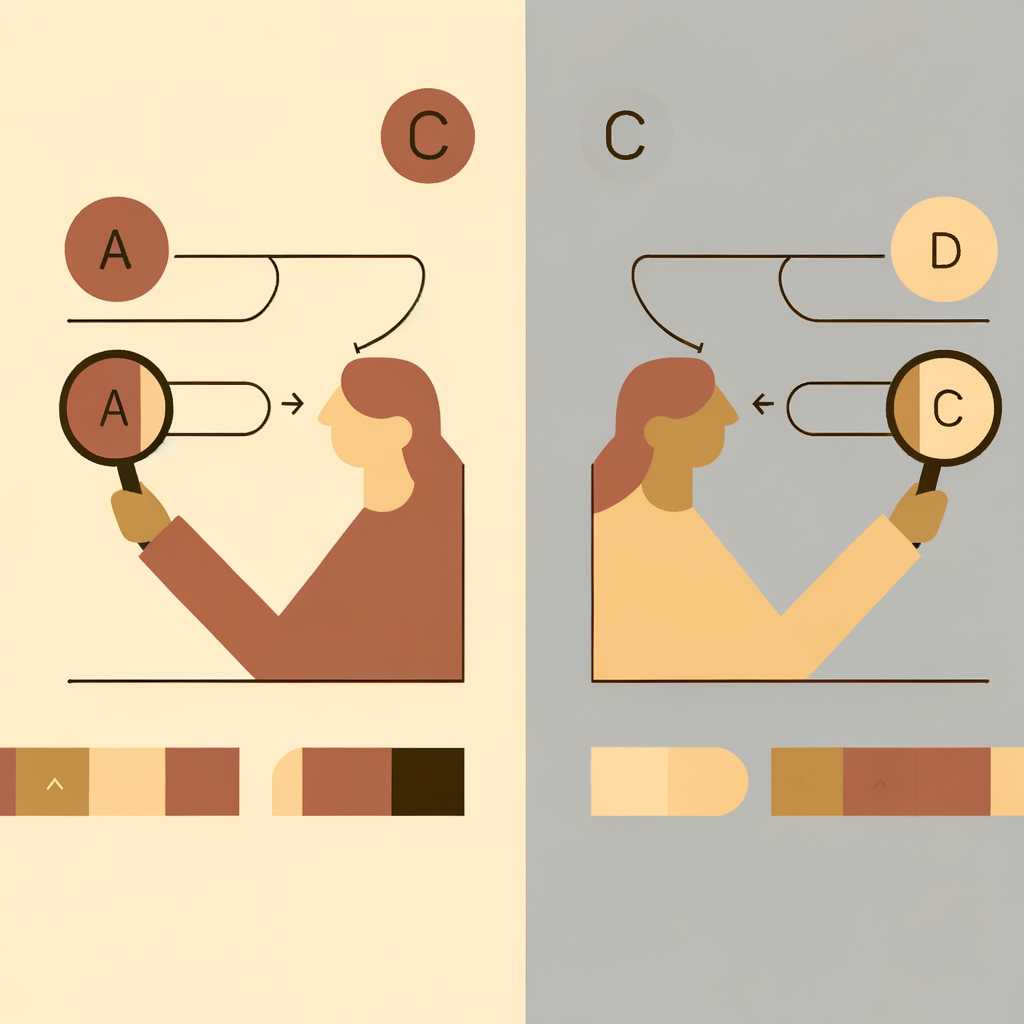
Use Logical Reasoning and Subject Knowledge
Even with partial knowledge, logic can guide you. Ask yourself: Does this answer make sense in the real world? Is it consistent with general principles of the subject? If two answers seem very similar, one of them is likely the correct answer (test writers often include a 'close but wrong' distractor next to the right answer). If two answers are opposites, one of them is very likely correct. Draw on related knowledge — even if you don't know the specific fact, you may know enough about the broader topic to reason toward the best choice.
When two answers are near-opposites (e.g., 'increases' vs. 'decreases'), the correct answer is almost always one of those two. Focus your energy on deciding between them.
- If If two remaining answers are direct opposites, do Focus all reasoning on choosing between those two — one is almost certainly correct..
- If If two remaining answers are very similar with a small difference, do Identify the exact difference and use subject knowledge or logic to determine which detail is accurate..
Common mistakes
- ×Ignoring pairs of opposite answers, which are strong signals that one is correct.
- ×Choosing an answer just because it sounds technical or impressive.
- ×Abandoning logical reasoning and guessing randomly out of frustration.
Step 5 of 6

Trust Your First Instinct (But Know When to Change)
Research on test-taking consistently shows that your first instinct is correct more often than not — your brain processes information subconsciously and surfaces a 'gut feeling' that reflects partial knowledge. Avoid changing your answer unless you have a clear, specific reason to do so (e.g., you recall a fact, or you realize you misread the question). Changing answers out of anxiety or second-guessing typically lowers scores. However, if you re-read the question and realize you misunderstood it, changing is absolutely the right move.
Write a small mark (like a dot or asterisk) next to questions you changed your answer on during review. Studies show first answers are correct more often, so track your changes to learn your personal pattern over time.
Common mistakes
- ×Changing an answer simply because you feel nervous or uncertain.
- ×Never changing an answer even when you clearly misread the question.
- ×Spending so much time second-guessing that you run out of time on other questions.
Step 6 of 6

Manage Time and Always Make a Selection
Never leave a multiple-choice question blank unless the test penalizes for wrong answers (e.g., some older SAT formats or GRE subject tests subtract points for incorrect responses — always check the rules first). On most modern tests, a blank is always wrong, while a guess has a chance of being right. If time is running out, quickly apply the elimination strategy to remaining questions and select the best remaining option. For penalty-free tests, even a random guess is better than no answer. Budget your time so you can attempt every question.
On timed tests, skip difficult questions and mark them to return to later. Answer all the questions you know first, then go back — this ensures you don't lose easy points while stuck on a hard one.
- If If the test penalizes for wrong answers, do Only guess if you can eliminate at least one or two options, making the expected value of guessing positive..
- If If the test does NOT penalize for wrong answers, do Always fill in an answer — never leave a question blank..
Common mistakes
- ×Leaving questions blank on a test that does NOT penalize for wrong answers.
- ×Spending too long on one hard question and running out of time for easier ones.
- ×Forgetting to check the test's scoring rules before deciding whether to guess.
Sources
Generated from model knowledge — verify any factual claims independently.